SCUDO’s mission is to make every gesture safer, without limiting you.
ANTIBACTERIAL EFFICACY
Bacterial strains and exposure times
ISO 22196:2011, ASTM E 214.
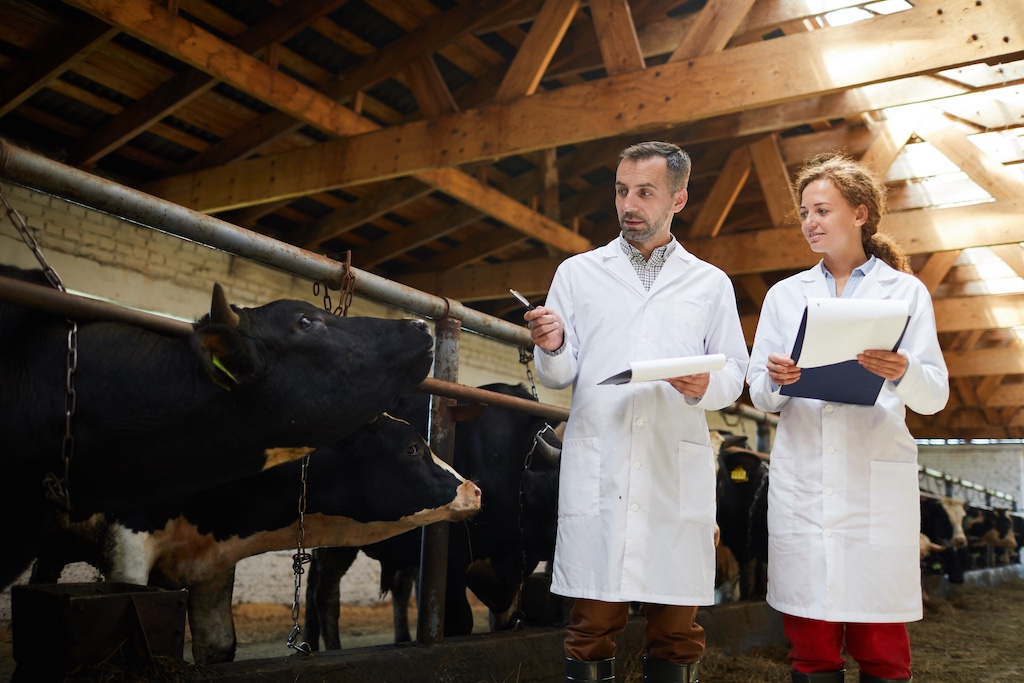
Furthermore, the Department of Biomedical, Surgical and Dental Sciences – One Health Section of the University of Milan has created a specific method for livestock farming to simulate the work environment.
Bacterial strains and exposure times
The charge reduction test was performed using a 24-well cell culture plate (Ø16 mm, volume 1 mL).
.To allow for better handling of the elastomer sheets, a rectangular section measuring 5cm x 8cm was sampled and a disk of suitable dimensions was “punched” for insertion into the above-mentioned plate.
Using sterile forceps, each disk was placed on the bottom of a well and covered with 1 mL of each bacterial suspension.
We used six bacterial species (Staphylococcus aureus ATCC 6538, Streptococcusgalactiae ATCC 13813, Escherichia coli ATCC 25922, Salmonella ATCC 25928, Listeria ATCC 13932 and Legionella ATCC 33152) at two different concentrations: 10³ UFC/mL and 10⁴ UFC/mL.
The exposure times (time-points) used to have an indication of the possible dynamics of bacterial load reduction were:
– T0: contact with elastomers
– T1: 5 minutes post-contact (PT)
– T2: 30 minutes PT
– T3: 1 hour PT
– T5: 6 hours PT
– T6: 24 hours PT.
At each time point, an aliquot of microbial suspension (50 µL) was appropriately diluted in sterile saline (0.9% NaCl) and seeded (50 µL) on a plate with solid medium. After incubation at 37°C for 24 hours, the colonies were counted to obtain the starting load at each time point.
ANTIVIRAL EFFICACY
Analysis Methodology
Viruses and cells used and methods
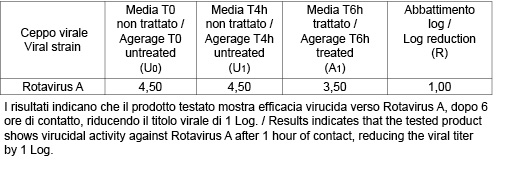
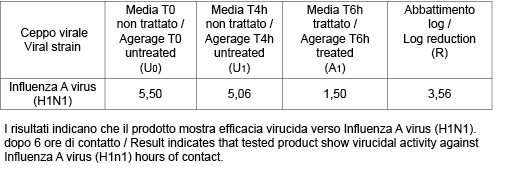
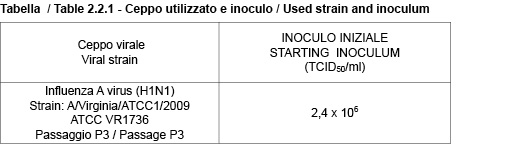
The strain used is described in table 2.2.1, together with the host cell line. The original virus was thawed and adsorbed onto the cells at approximately 90% confluence as described in the UNI EN 12353:2021 standard, and then left to incubate at 35°C ± 1°C with 5% CO2 until a TID50/ml titre of approximately 6 Log was obtained.
MDCK cells are grown in MEM + 10% FBS, supplemented with L-glutamine, non-essential amino acids, penicillin and streptomycin (growth medium).
Cells at 80-90% confluence are used to perform the test, and the medium is supplemented with trypsin, BSA and HEPES buffer (maintenance medium).
Calculate antiviral activity
Evaluation of results
Viral infectivity is calculated with the following formula:
S = (10 x P)
where:
S: virus infectivity per ml for suspension of the test
P: average TCID50
N = (10 x TCID50/ml x V) / A
where:
N: infectivity of the recovered virus per cm2 of sample
V: volume in ml of the SCDLP broth added to the sample
A: surface area of the cover film in cm²
The following formula is used to calculate antiviral activity:
R = (Ut – Uο) – (At – U0) = Ut – At
Where:
R: antiviral activity
Uο: mean of the logarithm of TCID50/cm2 of the three untreated samples immediately after inoculation
Ut: mean of the logarithm of TCID50/cm2 of the three untreated samples after the contact time
At: mean of the logarithm of TCID50/cm2 of the three treated samples after the contact time
The antiviral efficacy of the treatment is evaluated based on the logarithmic reduction R.
Safety
SCUDO Elastomers allow you to guarantee high levels of hygiene thanks to their properties, eliminating viruses and bacteria from surfaces in a constant and complete way.
Savings
Thanks to SCUDO Elastomers, applied in a variety of sectors, it is possible to reduce the risk of infections from viruses and bacteria, with a reduction in the use of antibiotics.
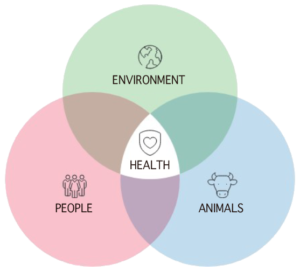
Health at the centre
Our priority is everyone’s health.
Effective against viruses and bacteria
Find out more about the possible applications of SCUDO
LOCATION
Scudo Technology
Via Provinciale 4/G
24060 Adrara San Martino (BG) – Italy
CONTACTS
info@scudo.technology
T +39 342 6169584
FOLLOW US
LEGAL